


Will MLB Follow In The NBA's Footsteps? Can Superteams Save The League?

Following a hectic trade deadline spearheaded by the Dodgers' All-Star acquisitions, questions loom about star-studded rosters.

We’ve seen it in the NBA for years now. First, in 2010 when LeBron took “his talents to South Beach,” teaming up with Dwayne Wade and Chris Bosh in Miami. Then, a few years later, in 2016, when former-MVP Kevin Durant decided “hey, if you can’t beat them, you join them” by leaving the Oklahoma City Thunder to join 2x MVP Stephen Curry and a stacked Warriors team that had just set the record for most wins in NBA history.
Now, LeBron and Durant have formed new superteams, on opposite coasts, Los Angeles and Brooklyn, respectably. LeBron will enter the 2021-2022 NBA season playing for the Lakers alongside somehow still 28-year old and 8x All-Star Anthony Davis, in addition to the player holding claim to the most triple-doubles in NBA history, Russell Westbrook. Over in Brooklyn, Durant has crafted an ever-so dislikable Nets team with the league diva and 7x All-Star in his own right, Kyrie Irving, plus former-MVP and 3x scoring champion James Harden.
As you can see, it’s an old tale, but it’s beginning to take on a new narrative.
Enter Major League Baseball.
Many argue that baseball is a dying sport. There is certainly a lot of truth to that. “America’s Greatest Pastime” is rapidly losing popularity due to it’s glacially slow speed and refusal to evolve, while every other sport has been willing to do so. As a result, World Series viewership has fallen to just 22% of what it once was over 40 years ago. From 44.279 million in 1978 down to just 9.785 million this past year. Yikes.
I’ll give MLB a bit of credit for putting in place some rules to speed the game up and make it more exciting: three batter minimum for pitchers, banning “sticky” substances for gripping, and putting a runner on base in extra innings (although the latter will likely dissipate following culmination of the 2021 season). Unfortunately, these measures alone likely will not be enough to save the sport from free fall.
As much as I hate to say it, the key could be in modeling after the NBA-- crafting a “big-market reigns supreme” type of league via the creation of superteams.
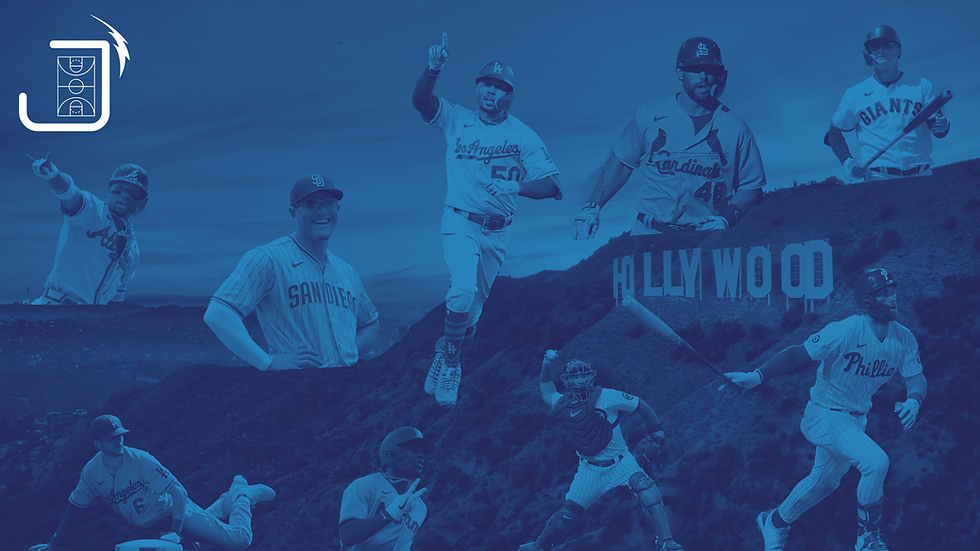
We are already beginning to see it with the Los Angeles Dodgers. Having already been seen as World Series favorites, with a plethora of Former MVPs, Cy Young Award Winners and All-Stars such as Mookie Betts, Cody Bellinger, Clayton Kershaw, Trevor Bauer (maybe?), Walker Buehler, David Price, Kenley Jansen, Justin Turner, and Max Muncy, they just added 3x Cy Young Award winner, Max Scherzer, and arguably one of the best shortstops in MLB in Trea Turner. Sounds kind of like a Superteam to me, huh?
This is almost unprecedented in MLB due to a confluence of factors.
Number one: Baseball teams are much larger than basketball teams. Therefore, a team needs a lot more than three great players to form a great team. For example, arguably the greatest MLB player of all time, Mike Trout, has never even won a playoff game. That would be unheard of in the NBA. In baseball, there are nine hitters, only one area of the field a player can cover, and one pitcher in at a time. Mike Trout could hit a home run every at bat or make every incredible play in the field, but there are still eight guys around him playing their own individual game, too. As a result, if they do not play well, the team will not play well. We can also insert Jacob deGrom here. In 2018, he had the lowest ERA in the league at 1.70, but only won 10 out of his 32 starts for the Mets. That is because he can only pitch so many innings. If relievers blow it in the late-innings or his team doesn’t hit well, they likely will not win that game no matter how well he pitches. We must also account for the fact that starting pitchers only pitch once every five games or so. This means that no matter how good a pitcher is on his given start, if the other four starters do not perform well, the team likely won’t have a good record. The rules and structure of baseketball facilitates the ability of players to cover the entire playing surface and be in on every play-- that is impossible and not allowed in MLB, meaning spending heavy on one or a few players doesn’t necessarily constitute a superteam or even success at all.
Number two: It’s really tough to be good one both sides of the field. In the NBA, each player is forced to play offense and defense. While this is mostly true in MLB as well, the most important position on defense is pitcher. Aside from Shohei Ohtani, there is nobody in the league that can hit and pitch at an elite level. This means that teams need to balance their money between position players and pitchers, making it much more difficult to load up at every position. Oftentimes, teams are explosive at bat, but their pitching doesn’t measure up to standards or vice-versa… resulting in the difference between good and great teams.
Number three: This one is somewhat debatable, but there is undoubtedly a lot of truth embedded in here. I believe that baseball is more of a managerial/strategic game, and I would also argue that there is more luck/fortune involved. As a result, you cannot just overpower a team with a couple of players at one time. A team needs to know where to play in the field, when to bunt, when to steal, where to hit the ball to find the gaps, where to place guys in the batting order, what pitch to throw in a given situation, where to place that pitch etc. This means that a team can hit the ball hard or throw the ball well, but one tiny mistake in any of those areas can really cost a team the game, especially in a lower scoring game like baseball. I’m not saying mistakes don’t matter in basketball, but in baseball they are usually more detrimental-- meaning teams historically have looked to find a lineup that fits together at bat and in the field… not necessarily just the best overpowering players in the league like many NBA executives look for.
While the majority of what I just mentioned is still very relevant, we may be witnessing a new age right in front of us. The luxury tax is certainly of note here as well. Instead of a normal salary cap like the NBA, NFL, and NHL, Major League Baseball has a luxury tax that teams can exceed if they are willing to face a penalty. Each year, this penalty increases in cumulative fashion, in correspondence with the number of years a team has been over the tax. This year, there are three teams over the tax-- The Red Sox, Yankees, and the Dodgers (who are $42.5M over).
It will be interesting to see if other teams will try to follow in the Dodgers’ footsteps to craft superteams. Personally, I hope teams won’t. I’m a traditionalist. I appreciate baseball in its strategic, natural form and think superteams would take away from the chemistry and camaraderie it takes to create a title-destined team. However, on the other hand, baseball needs change and it’s hard to argue that it hasn’t worked out for the NBA, who have hovered around 20 million viewers per Finals Game when superteams have played in them. Interestingly enough, the league actually saw a drastic decrease in viewership this past finals with non-superteams playing against each other, the Bucks and Suns. My assumption is if the Dodgers go back-to-back this season, we may begin to see a lot of big-market teams go well over that luxury tax threshold, looking to acquire the big stars when they can. The only question is, can it work in the same fashion as it has in the NBA? My inkling is no, but there’s only one way to find out.



Comments